Navigating uncertainty: how the Middle East conflict is shaping expectations and coping strategies of firms
Navigating uncertainty: how the Middle East conflict is shaping expectations and coping strategies of firms
Prepared by Katalin Bodnár, Davide Fantino, Sara Lamboglia and Laura Lebastard
The Survey on the Access to Finance of Enterprises (SAFE) in the euro area for the second quarter of 2026 sheds light on the exposure of firms to the conflict in the Middle East, its impact on their expectations, and their coping strategies.[1] Building on earlier analysis based on the survey for the first quarter of 2026, which revealed a significant shift in expectations among firms surveyed after the outbreak of hostilities in the Middle East on 28 February 2026, ad hoc questions included in the wave for the second quarter provide further evidence on how the conflict is affecting euro area firms.[2] The latest survey round also allows us to assess whether the distribution of firms’ answers shifted after the announcement of the Memorandum of Understanding (MoU) between Iran and the United States on 14 June, with about a quarter of respondents replying after the announcement was made.[3] Maritime attacks subsequently resumed in early July, highlighting the continued relevance of firm-level analysis on the impact of the conflict.
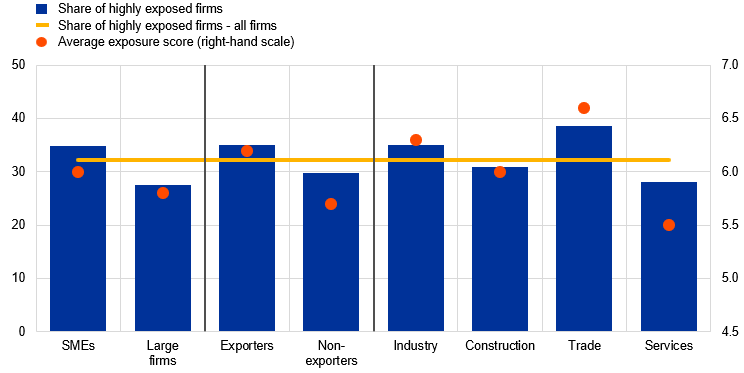
Firms in the trade sector, exporters and small and medium-sized enterprises (SMEs) reported the highest exposure to the conflict in the Middle East. On average, large firms reported being less exposed to the conflict than SMEs, with 28% reporting an exposure score of over seven on a scale of one to ten, compared with 35% for SMEs (Chart A). Exporting firms reported a higher degree of exposure on average than non-exporters. This likely reflects two factors: (i) exporting firms may operate in geographically distant markets that are more directly affected by the conflict in the Middle East than the euro area; and (ii) exporters are more likely to engage in importing activities (Bernard et al., 2012), heightening their vulnerability to global supply chain disruptions. While exporters tend to be larger firms, the greater exposure of SMEs suggests that size and internationalisation may affect firms through different channels: exporters are more exposed given their stronger integration into global trade networks, whereas SMEs may have limited ability to absorb cost shocks or adjust supply chains. SMEs are also more reliant on consumer demand and more sensitive to the energy shock associated with the conflict.[4] Across sectors, the largest share of highly exposed firms is found in the trade sector (comprising wholesale and retail trade) and the smallest share in other services. The lower exposure of firms in the other services sector likely reflects their smaller share in energy costs and a stronger domestic focus. These heterogeneities are confirmed when looking at average exposure scores as an alternative metric of the exposure of firms to the conflict.
Chart A
Share of firms that are highly exposed to the conflict in the Middle East and average exposure score, by firm type
(percentages and score 1-10)
Sources: SAFE and ECB staff calculations.
Notes: Survey-weighted results. “Highly exposed firms” refer to those that indicated a score of over seven on a scale of one to ten for the question “To what extent has the war in the Middle East (including higher energy prices, supply chain and shipping disruptions) affected your firm’s business?” “Trade” stands for wholesale and retail trade. All the differences between average scores are statistically significant. The latest observations are for the second quarter of 2026.
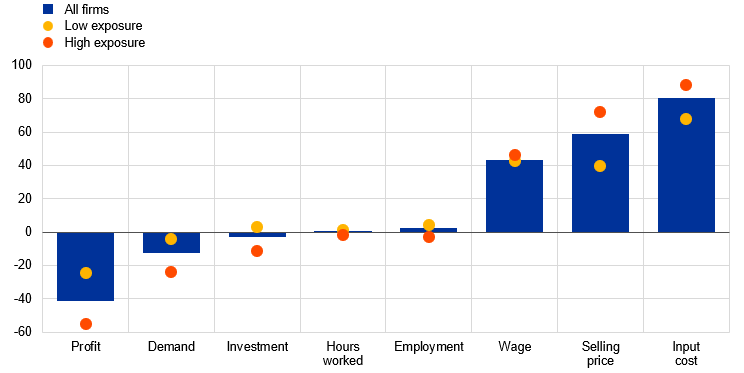
The conflict in the Middle East has primarily affected firms’ expectations for nominal variables and demand, while the impact on other real variables is seen as muted. Firms reported that the conflict has had the largest effect on expectations for nominal variables, with a net 79% of firms expecting higher input costs, a net 58% higher selling prices and a net 43% higher wages over the next 12 months (Chart B). While more highly exposed firms reported an upward impact on expectations for input costs and selling prices than those that are less exposed, the effect on wage expectations was broadly the same across firms. This suggests that firms view wage developments as being driven primarily by broad-based inflationary pressures – as workers may seek compensation for expected increases in the cost of living – rather than by the degree of exposure of their sector or firm. A net 40% of firms reported that the conflict has had a negative impact on profit expectations. Looking at real variables, a net 14% of firms reported lower expectations for demand. By contrast, firms anticipated no change in their expectations for employment, average hours worked and investment growth, with net percentages for these variables close to zero. However, looking solely at highly exposed firms, a net 11% reported that the conflict has had a negative impact on their expected investment growth. Splitting the sample before and after the date of the MoU announcement showed little change in the distribution of answers. This suggests that the announcement had a limited effect on firms’ assessment of the economic implications of the conflict.
Chart B
Impact of the conflict in the Middle East on firms’ expectations
(net percentages)
Sources: SAFE and ECB staff calculations.
Notes: Survey-weighted results. In response to the question “How does the war in the Middle East and the associated changes in energy prices affect your firm's expectations over the next 12 months?”, firms were able to report whether their expectations had increased, decreased or remained unchanged. Net percentages were calculated as the share of firms replying that their expectations had increased minus those replying that their expectations had decreased. “Low exposure” refers to firms that indicated a score of less than five on a scale of one to ten for the question in Chart A. The latest observations are for the second quarter of 2026.
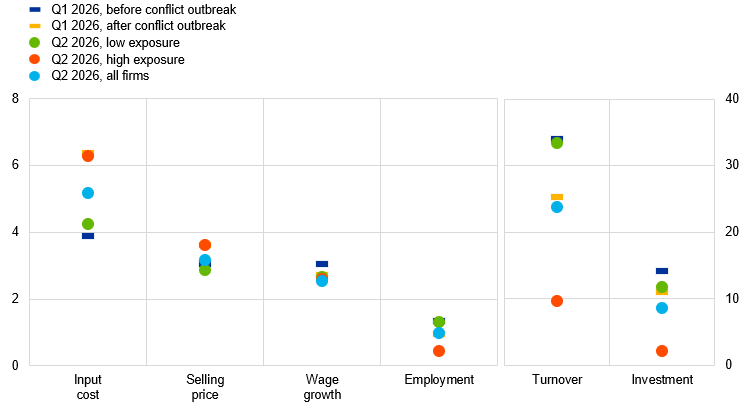
Firms’ quantitative expectations for changes in input costs and selling prices remained elevated overall and above pre-war levels, but wage growth expectations eased (Chart C). Firms that were highly affected by the conflict reported higher cost and price growth expectations – comparable to those observed in responses collected just after the outbreak of the conflict on 28 February –whereas the expectations reported by less affected firms aligned more closely with pre-conflict survey responses. By contrast, wage growth expectations eased somewhat compared with the previous round, both for highly exposed and less exposed firms. The easing of wage growth expectations in the second quarter compared with the first quarter appears to contrast with the net 43% of the firms that reported higher wage expectations following the outbreak of the conflict. However, this likely reflects that if the conflict had not existed, wage growth expectations would have slowed more significantly. This interpretation also seems to be consistent with the qualitative responses in the ECB’s Corporate Telephone Survey on expectations for selling prices and wages (see Elding et al., 2026).
Chart C
Firms’ expectations by exposure and interview date
(left-hand scale: percentage changes over the next 12 months; right-hand scale: net percentages of expected increases over the next three months)
Sources: SAFE and ECB staff calculations.
Notes: Survey-weighted average expectations of changes. Regular SAFE questions about expectations. Input cost, selling price, wage and employment expectations refer to the next 12 months. Turnover and investment expectations refer to three months ahead. Net percentages of expected increases were calculated as the share of firms replying that their expectations had increased minus those replying that their expectations had decreased. The “high exposure” and “low exposure” groups are classified as in Chart B. The latest observations are for the second quarter of 2026.
Qualitative expectations for turnover and investment growth over the next three months and employment growth expectations for the next 12 months weakened in the second quarter compared with pre-conflict levels. The expected moderation was noticeably more pronounced for turnover than for investment. Highly exposed firms drove the expectations down, with only a net 10% of firms expecting turnover to increase and a net 2% expecting investment to rise – well below the figures recorded among all firms before the outbreak of the conflict in the first quarter (a net 34% and a net 14% respectively). Employment growth expectations over the next 12 months stood at 1.4% in the first quarter, before the outbreak of the conflict, and decreased to 1.0% in the second quarter when highly affected firms expected lower growth (0.5%).
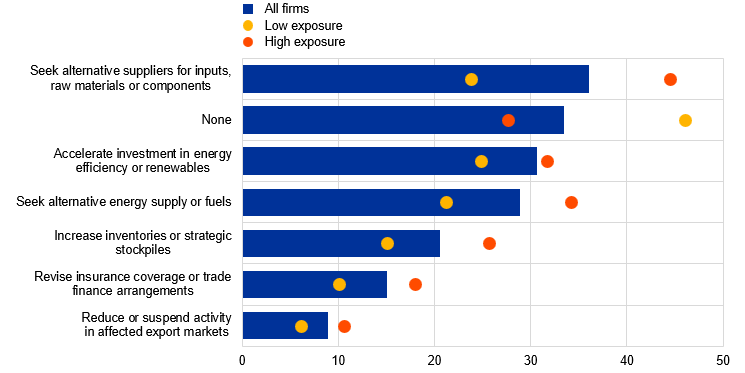
About two-thirds of respondents are taking action in response to the conflict by seeking alternative suppliers and accelerating investment in energy efficiency (Chart D). The most common strategies reported by firms in response to the conflict were: seeking alternative suppliers for inputs, raw materials or components (36%), accelerating investment in energy efficiency or renewables (31%), and seeking alternative energy suppliers or fuels (29%). Almost half of low exposure firms reported taking no action, compared with only 28% of highly exposed firms. For the second group, the most common strategy was to seek alternative suppliers for inputs (44%). Very few firms reported having reduced, or planning to reduce, their activity in affected export markets. At the same time, a significant share of the firms that reported a low degree of exposure are also taking action to hedge against future shocks stemming from geopolitical tensions.
Chart D
Strategies of firms in response to the conflict in the Middle East
(percentages of respondents)
Sources: SAFE and ECB staff calculations.
Notes: Survey-weighted percentages of firms answering the question “Which of the following actions has your firm already taken or which plans has it made for the next 12 months in response to the geopolitical tensions in the Middle East?” Firms were able to select multiple options. The “high exposure” and “low exposure” groups are classified as in Chart B. The latest observations are for the second quarter of 2026.
References
Bernard, A., Jensen, B., Redding, S. and Schott, P. (2012), “The Empirics of Firm Heterogeneity and International Trade”, Annual Review of Economics.
Dausa i Noguera, N., Dimou, M. and Kouvavas, O. (2026), “Tracing the ripple effects of the Middle East war on euro area consumption”, Economic Bulletin, Issue 5, ECB.
European Central Bank (ECB) (2026), “Survey on the Access to Finance of Enterprises in the euro area - Second quarter of 2026”, July.
Elding, C., Morris, R., Riedel, Z. and Roma, M. (2026), “Main findings from the ECB’s recent contacts with non‑financial companies”, Economic Bulletin, Issue 5, ECB.
Fantino, D., Ferrando, A., Groß, J., Lamboglia, S., Lebastard, L., Rariga, J. and Schmidt, M. (2026), “How the war in the Middle East is reshaping euro area firms’ expectations”, The ECB Blog, ECB, 26 May.
For more information, see the ECB’s SAFE report for the second quarter of 2026.
For previous analysis see Fantino et al. (2026).
The fieldwork took place between 21 May and 26 June 2026.
See Dausa i Noguera et al. (2026).
Další články

Česko se od října vrací k regulaci cen pohonných hmot. Podobný zásah chystá…

Vláda obnovuje regulaci cen PHM a snižuje spotřební daň z nafty na evropské…

Německý VW výrazně snížil očekávání pro výhled provozního zisku

Pro a proti: Zkrotí vláda ceny benzinu? Teď je to jiné než na jaře, zní z ANO.
38. týden na trhu pohonných hmot ČMKB - nafta v průměru za 28,86 Kč/litr

Šestnáct nehod za 48 hodin. Takový byl třetí zářijový víkend pro hasiče v…
Více článků »